Thursday, May 9, 2013

Page 21


There is another Saint John the Baptist, 1455, attributed to Desiderio da Settignano in the Louvre Museum that is also a fine piece. Most of his sculptures feel as if they are in dialogue and have a beautiful inner presence, stone was obviously Settignano's medium. Another gorgeous offering to God is The Young Saint John the Baptist, 1450-1453, by Desiderio da Settignano held at the Bargello National Museum in Florence, a bronze relief, that is yet again exquisitely rendered. Obviously the theme of Saint John was one that Settignano identified with or the youth as a divine servant of God, the fleece seems to represent something secular too.


Henri Le Secq, photographs


Thursday, May 2, 2013

Page 20


Tilman Riemenschneider, 
Saint Jerome with the Lion, 1490-1495


In the Louvre Museum in Paris, there is also a Settignano made of stone of Saint John the Baptist with the Christ Child. This is also an exquisitely carved piece. The layout of the European Renaissance and Gothic sculpture is also something of a treat in the Louvre. The sculpture is in relief marble and is very refined in technique. There is also a Gregor Erhart, St. Mary Magdalene, 1510, in the Louvre that is also a masterful work. The German use of lime wood, also known as Gothic sculpture, was at its peak in this period. The French also engaged in wooden sculpture from an early period but were more highly advanced with stone carving especially Gothic sculpture on the front of churches.


Gregor Erhart, (c. 1465-1540), Christkind,
Museum fur Kunst und Gewerbe, Hamburg


Henri Le Secq, Chartres Cathedral, 1852


Thursday, April 25, 2013

Page 19


St. Mary Magdalene, Gregor Erhart, 1510, 
Musee du Louvre, Paris


Most of the stone work in the Bargello in Florence has to be there for climatic reasons so the stone can be housed naturally. The room that houses the Martelli Saint John by Settignano and Donatello also houses mostly Donatello sculptures. The rest of the museum includes sculpture from other Renaissance sculptors such as Verrocchio and the della Robbia family. Donatello also has a large amount of sculptures housed in the Museo dell'Opera del Duomo in Florence where you will also find Saint Mary Magdalene.


Verrocchio, Bust of a Lady, c. 1480, 
Frick Collection, New York


Tilman Riemenschneider


Tilman Riemenschneider


Musee du Louvre


Wednesday, April 17, 2013

Page 18


Desiderio da Settignano (attributed to), Young Deacon, 
ca. 1455-1460, San Lorenzo, Florence


Desiderio da Settignano (attributed to), Young Deacon (detail), 
ca. 1455-1460, San Lorenzo, Florence


Maybe even before conception the love felt and gained by God in the parents of a child has a bearing, along with the position of the moon, the stars and the planets. Often one wonders about the premise of a child by God or if anyone acknowledges the divine contribution of the heart. Settignano and Donatello, along with many other Italian Renaissance artists, appear to have been working for an equation for God as though they were already born in Heaven. The fleece of Saint John feels like it would have been golden in the minds of the two carvers or stonemasons. So, perhaps the sculptures, each made, were already conceived in the womb or at least in some part of their divine beings. Time often feels like it goes backwards and our life is to try and work out what went wrong with the human race or to re-edit the script. All cycles of life have an end in the evolution of the species and the planet. And it is also important to look back on a time with a different interpretation to equate a greater understanding.


Donatello, Beardless Prophet, c. 1416-1418, 
Museo dell'Opera del Duomo, Florence


Donatello, Saint John the Evangelist, c. 1408-1415,
Museo dell'Opera del Duomo, Florence


Friday, April 12, 2013

Page 17


Donatello, Judith and Holofernes, c. 1456-1457


Donatello, David, c. 1444-1446, 
Museo Nazionale del Bargello, Florence


Donatello, David, c. 1408-1409,
Museo Nazionale del Bargello, Florence


You feel the perceptions of earth are almost predetermined before birth, even the sensations of light, colour and sound while you are in the womb would have an influence, let alone your bloodline makeup. It would be interesting to know when we start thinking and perceiving. The difficulty of being in a place where you are misunderstood feels often more about those of a similar bloodline than anything else. The quality of Settignano's stone carving was at a very advanced stage early on and unlike Donatello who feels more emotionally charged, Settignano was more of an intellectual. So, other than Settignano's parentage, upbringing and life experience, you feel you are looking at the work of someone who both had a very refined sensibility and the power to think his way around form. Therefore, some would be learnt, perceived or imagined and the rest cultural knowledge from his bloodline.


Desiderio da Settignano, 
The Young Saint John the Baptist, 
c. 1450-1453, 
Museo Nazionale del Bargello, Florence


Friday, April 5, 2013

Page 16


Donatello, David, c. 1444-1446, 
Museo Nazionale del Bargello, Florence


Donatello seemed to prefer clay modelling and woodcarving rather than stone masonry. Perhaps because they were more products from above the earth or of the earth. Maybe feeling more French in technique than Italian the sculptures are more expressive and this is a medium that suited his oeuvre. The sculpture housed in the Bargello National Museum does mainly seem to be made from stone. Given how productive Donatello seemed to be as a sculptor perhaps the stone pieces were completed in the workshop by students and those working under his direction. Settignano was supposed to be his predecessor but did not live very long.


Donatello, Judith and Holofernes, c. 1456-1457


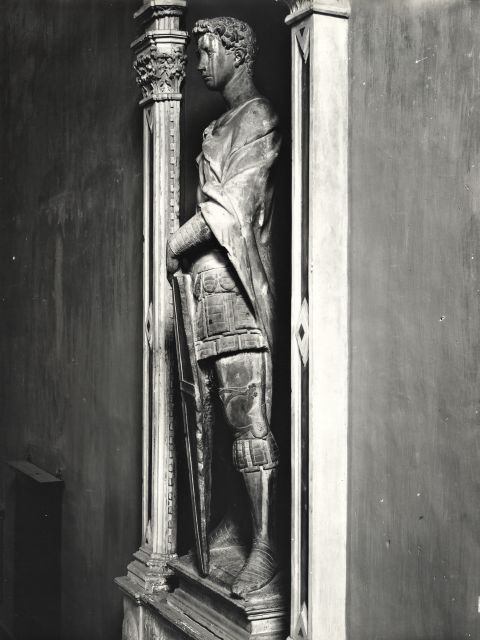
Donatello, St. George, c. 1416-1417, 
Museo Nazionale del Bargello, Florence


Donatello, David, c. 1408-1409, 
Museo Nazionale del Bargello, Florence


Sunday, March 31, 2013

Page 15


Donatello, Saint John the Baptist, 1438, 
Santa Maria dei Frari, Venice


Donatello, David, c. 1444-1446, 
Museo Nazionale del Bargello, Florence


The use of stone and bronze for sculpture also feels there is an interesting parallel to God. The sculptors of the Italian Renaissance seem to be like they were born in heaven or were part of God's domain. The use of stone, for example, Carrara marble, from the side of the mountain, would be like a substance originally from a volcano from the bottom of the sea, a place where many believe heaven exists or you are led to when you die, cleansed on the volcanic journey projected towards the sky. So, the substance is already from Gods divine earthly domain or nature. Bronze on the other hand would be made underground or in caverns using melted elemental properties such as copper mixed with brass or zinc, so, perhaps would be thought of as being associated with underworld Gods from ancient Rome or Greece. Therefore, Settignano's and Donatello's Saint John, made of marble, was already made from a divine substance of nature, fashioned by two divine principals of God, so twice as heavenly. The bronze and wooden sculptures of Donatello seem equally as divine. 


Donatello, Amore-Attis (detail), c. 1440-1443, 
Museo Nazionale del Bargello, Florence


Desiderio da Settignano (attributed to), 
Portrait of a Lady, said to be Marietta Strozzi, 1460,
Bode Museum, Berlin