Sunday, March 24, 2013

Page 14


Hans Holbein the Younger , St John the Apostle, 
c. 1517, Kunstmuseum Basel


Settignano's and Donatello's Saint John the Baptist was already covered in a golden fleece. The garden feels like it exists more in the hearts and souls of men rather than its reflection in nature but with the grace of heaven in your eyes and gods love in your heart, heaven on earth is also apparent. All earth is affected by Gods divine garden or love.


Matteo Civitali, Saint John the Baptist, 
c. 1480, Bode Museum, Berlin


Friday, March 22, 2013

Page 13


Saint Mary Magdalene (detail), c. 1453-1455, Donatello


The tendrils of love seem to have echoed the footsteps of the Christian pilgrims who followed the divine pathway to God or to a garden of earthly delights. With Settignano you get the impression that his soul or blood ties were of a very royal or refined nature and his reflection of the love of Christ was also apparent with other secular themes. Donatello, although a different sensibility and personality also had a very profound understanding of his eternal relationship to God. His sculpture of Mary Magdalene reminds us of her spiritual vocation and finding God in the desert almost with the covering of her body with her hair.  


Friday, March 15, 2013

Page 12


Pisanello, Portrait of Leonello d'Este, c. 1441, 
Accademia Carrara, Bergamo


Pisanello, Portrait of Princess Ginevra d'Este, 
c. 1435-1449, Louvre Museum, Paris


The garden theme seemed quite common as a subject amongst the artists of Padua and surrounds or those en route of their Christian pilgrimage. For example, Pisanello's paintings of the family d'Este who seem to be surrounded by flora and butterflies. The High Altar of Donatello also suggests a garden theme as well as the artists of Francesco Squarcione's workshop. This is evident in paintings of Botticelli in Florence and Settignano also seems influenced by this equation with God.


Sandro Botticelli, Primavera, c. 1482, 
Uffizi Gallery, Florence


Sandro Botticelli, The Birth of Venus, c. 1483-1486,
Uffizi Gallery, Florence


Sunday, March 10, 2013

Page 11


Andrea del Sarto, Saint John the Baptist, c. 1528, Pitti Palace, Florence


With circular thoughts it is hard to not equate reality and dream or consciousness and the unconscious or the rational and irrational with God the infinite and finite beings. Some feel the presence or death in forests or where you would find spirits of goddesses others think they live in the walls of houses. This equation with nature seems quite prevalent in Italian thinking, even today. One feels like talking about a tree would be the same as talking about God. You feel nature in Italian art as well. For example, Saint John the Baptist's fleece, although highly refined, we are still reminded of the smell of the earth and the rest of the flock. In talking about religious subjects there is the idea of the garden being synonymous with God.


John Everett Millais, Christ in the House of His Parents 
(The Carpenter's Shop), c. 1849, Tate Britain, London


Sunday, March 3, 2013

Page 10


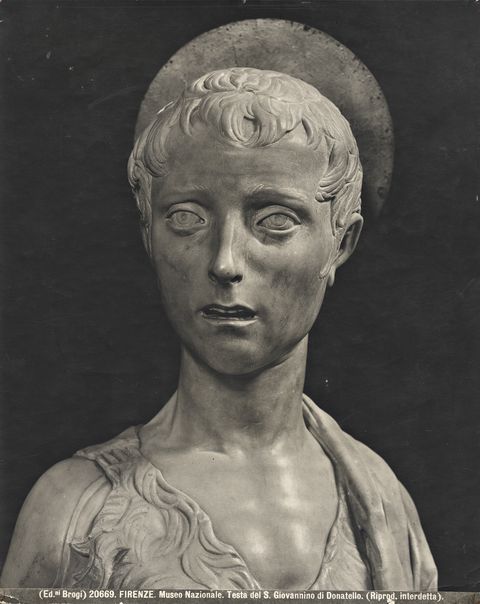
Martelli Saint John, ca. 1440-1457, Donatello and Settignano


Sculpture seems like an occupation that consumes a different outlook and pattern of thinking. The ephemeral quality some assume God to have, given an earthly presence or thinking with philosophy. Some people tend to think only in straight lines or as though the world is flat. This comprehension always felt like it was describing the equator rather than the circumference of the earth. Almost as if you had an orange and cut it in half, this would be the equator. So, when thinking about sculpture and the human being as a microcosm of the macrocosm for example, you would not think of the head as anything than in the round. But you would be making an assessment about width and depth, for example, there being an equator through the mind and the north and south pole equalling the top of the head and your oesophagus opening or chin, respectively. Stone sculpture could therefore describe the equation of the valley and the mountain again. Planet earth being an old star, or made of rock and the rock also being above earths surface or as mountains to equal facial features such as the nose or the cheek bones. The centre of the earth would contain something like the pituitary gland in the centre of the skull or dark matter containing stardust and an entry to the universe. The earths surface or temperature would equal hell and above and below earth would equal heaven.


Wilhelm von Pluschow (1852-1930), Et in Arcadia ego


Tuesday, February 26, 2013

Page 9


Martelli Saint John, ca. 1440-1457, Settignano and Donatello


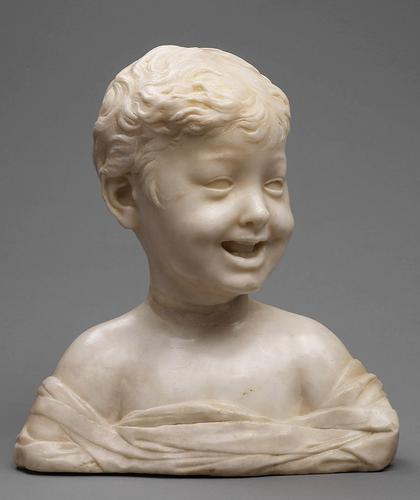
Unconsciously, we tend to think more while we are waking than dreaming. So, we are ascending our-self to God by dreaming and reflecting on the days events or on previous psychological events. Most of Settignano's sculpture tend to be of small children or infants that make you feel like he had a wonderful childhood or beautiful wife and gorgeous babies. They do tend to represent either baby Jesus or Christ and Saint John the Baptist as young children or in early adulthood. You get the feeling Saint John tended his flock solo rather than in the company of a shepherdess. But the Saint John represented here does not feel old enough to have contemplated the dream of Saint Anthony. Rather he feels consumed with his own thoughts and contemplative philosophy. 


Christ and Saint John the Baptist as Children, ca. 1455-1457, 
Desiderio da Settignano, Musee du Louvre, Paris


Laughing Boy, ca. 1460-1464, Desiderio da Settignano,
Kunsthistorisches Museum, Vienna


Friday, February 22, 2013

Page 8


Saint John the Baptist, ca. 1455, Desiderio da Settignano (attributed to),
Musee du Louvre, Paris


One of the sculptures of Saint John by Settignano does not portray similar characteristics to the collaboration of Donatello and Setttignano. Donatello seemed to have a far more French countenance than his counterpart and this is suggested in the way form is completed or the body is sculptured. One of the sculptures on the High Altar of S. Antonio of Padua seems to suggest self-portraiture with a similar equation or dimension of his skull.


S. Daniele, Basilica di S. Antonio, Padua, 
c. 1446-1450, Donatello


The form we portray in sculpture or an artwork often seems to suggest our own dimensions as though unconsciously they are inherent in our being. You often see this in an artist work but when two artists get together you have a double equation and if they are of a very high calibre or masterful it is as though you have two brains equalling one or a far more complicated ascension to God. The collaboration here of Donatello and Settignano feels like a very transcendent understanding of God was reached. In the height of the creation of a piece you wonder if even while sleeping you are sculpting or thinking.


Donatello and Settignano