Friday, February 15, 2013

Page 7


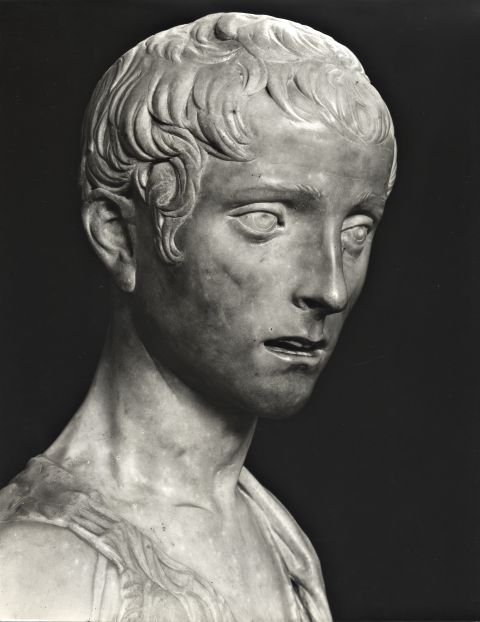
Martelli Saint John (details), ca. 1440-1457, Settignano and Donatello


Looking at sculpture in art books does you no divine favours but sculpture in the round is the only way to comprehend the work. The inner geometrical structures of the face, for example, can only be appreciated with an extreme knowledge of form or a contemplation of the third dimension. Stone seemed to be the preferred medium of Settignano and is also deeply profound in relief. The third dimension is difficult to understand as being incomprehensible or infinite but the dimension it holds in space depends on your relationship to God and infinity. The cross feels evident as an element when looking at the head of Martelli Saint John, almost as an internal structure. The inner geometry of form is perhaps something very rarely thought about these days but was common knowledge and a part of your learning and ascension philosophy in Renaissance Italy. The understanding of a tree, for example, equalled God through a complex system of believing. Often the Virgin Mary was sighted in trees by those who believed and prayed for a miracle. One feels that the fleece of Saint John had a very special and sacred purpose for those secular people of the Christian faith that was prevalent of the day. Even though the current staff feels like a late edition to the Settignano and Donatello sculpture, it is not offensive. The "V" of the fleece covering Martelli Saint John is significant, reminding us of the valley and the mountain equation or ascending the shepherd to heaven.




Sunday, February 10, 2013

Page 6


Martelli Saint John (detail), ca. 1440-1457, Settignano and Donatello


The size and proportion of Martelli Saint John by Settignano and Donatello also resonate Settignano's portraits of small children with their delicate features. You feel like the proportions were sent down from somewhere in the heaven on high. The extremely refined work was of a genre of sculpture from this time that also included della Robbia and Verrocchio. One wonders how such liberation of thinking occurred but often artists seem to have an extremely different philosophy of life. Geometry and cosmology were often thought about and seem to have had a completely different focus to the thinking of today. You would not be thinking a mathematical equation of the head could equal the pattern of the stars or the proportions of a tree or a flower could be of significance to the size, breadth and depth of the chest and length of the arms and legs, for example. But then again everything we look at and feel in our hearts has an influence on our perception.


Laughing Boy, c. 1460-1464, Desiderio da Settignano, 
Kunsthistorisches Museum, Vienna


The Little Boy, c. 1455-1460, Desiderio da Settignano, 
National Gallery of Art, Washington


 Portrait of a Young Boy, c. 1445, Luca della Robbia,
Museo Civico Gaetano Filangieri, Naples


Woman with Posy, c. 1475, Verrocchio, 
Museo Nazionale del Bargello, Florence


Tuesday, February 5, 2013

Page 5


Giotto, The Last Judgment, 1306, Cappella Scrovegni (Arena Chapel), Padua


Giotto was also a free thinker. You get the impression that Padua was the destination of Christian pilgrims because of Giotto's philosophy. Most of Giotto's paintings look like they have been completed or finished by other people and due to the vast number of churches he painted frescos in, he could not have physically painted them all himself.


Giotto, Crucifix, c. 1310-1317, Tempio Malatestiano, Rimini


Sunday, February 3, 2013

Page 4


Giotto, Crucifix, 1317, Museo Civico, Padua


Carlo Crivelli, The Dead Christ supported by Two Angels, c. 1470-1475, 
The National Gallery, London


In Padua, they were also given a large amount of freedom to paint their own style. And were then sent to various townships nearby to continue their own technique. This was continued with painters in Florence and a few of the surrounding towns especially in the hill towns. Sienna felt like a flourishing time in Gothic painting and was also a great place for Gothic sculpture, especially Giovanni Pisano and his father Nicola Pisano.


Giovanni Pisano, The Crucified Christ, c. 1285-1300, 
Victoria and Albert Museum, London


Tuesday, January 29, 2013

Page 3


Martelli Saint John, ca. 1440-1457, Settignano and Donatello


Martelli Saint John by Settignano and Donatello also demonstrates the idea that a mathematical equation could also be used to describe the figure in relation to the body. This equation has been demonstrated several times in the history of painting and especially the Renaissance. Several times in Renaissance history have geometric equations been used but none so exquisitely as with this piece. I am wondering where Settignano came from. He almost seems too gorgeous in his application to be an Italian artist. But then again when you look at the development of Gothic French sculpture next to Gothic painting and the development to Renaissance, the refinement is almost revolutionary in application. Perhaps Settignano came from a different place like Germany for secular studies. His technique seemed at the peak of Renaissance sculptures development. They seemed far more advanced in intellectual freedom. Unlike the Renaissance painters who seemed influenced by embroidery, Italian Renaissance sculpture seems far more influenced by architecture and churches. 


Friday, January 18, 2013

Page 2


High Altar (detail, also below), Basilica del Santo, Padua, c. 1446-1450, Donatello


The Giotto painting in the Scrovegni Chapel was a gorgeous offering to God. Like Giotto's work, Donatello sculpture always looks like it has been finished by his assistants or a hired professional, a common practice in Renaissance Italy. The organic quality in these pieces makes you feel like Donatello is in his element with clay modelling. The church where the late Donatello's High Altar is housed has an interesting mathematical equation with the design. You feel the altar is placed in the form of a cross and is brought forward to demonstrate this. The position the church faces would have been acknowledged by God and the front entrance also participates to this idea.


Thursday, January 17, 2013

Embroidering the Constellations


Martelli Saint John (detail), ca. 1440-1457, Settignano and Donatello


Embroidering the Constellations

This is a project I have been thinking of for a very long time. An equation about my favourite sculpture by Settignano and Donatello called Martelli Saint John, ca. 1440-1457. The sculpture is of Saint John as a youth and is one of the finest sculptures ever made. I remember on my first trip to Italy, I visited Rome for several days and then viewing sculpture in Florence was my kind of heaven. It was as though they had refined sculpture to its highest peak, the perfect size and proportion for sculpture, almost slightly smaller than life size. It was the first time I had seen the work of Luca della Robbia and Andrea del Verrochio as well.


Mary Magdalene, c. 1453-1455, Donatello


Donatello's Mary Magdalene, c. 1453-1455 was also a treat with her haggard face and sculptured hair, reminding you of Camile Claudel's Clotho, 1893, in Paris. Padua is also an interesting place to view Donatello and Giotto. The intellectual freedom in the city made for some very organic painting similar to embroidered fabric it emulated like Cosme Tura and Carlo Crivelli.


Cosme Tura


Carlo Crivelli


The garden theme was continued in the tomb of Saint Anthony by Donatello.


Donatello