Wednesday, May 7, 2014

123


Saint Mary Magdalene by Gregor Erhart, c. 1515-1520, at the Louvre Museum in Paris was once a monument in somewhere like the Church of the Dominicans in Augsburg, Germany. The Heavenly goddess describes the life of a mystic ascetic. This would include every day a prayer ceremony to take her Heavenly chorus via angels up to God. Apparently, the original sculpture was surrounded by angels ascending her prayer through Heaven. The sensual, idealized goddess would probably be modelled on the Swabian proportions of a female. Late Gothic, sculpture in the round of the polychrome tradition was at a well developed stage. This transcendent view of a pathway to God takes you to the cross.




Tuesday, May 6, 2014

122


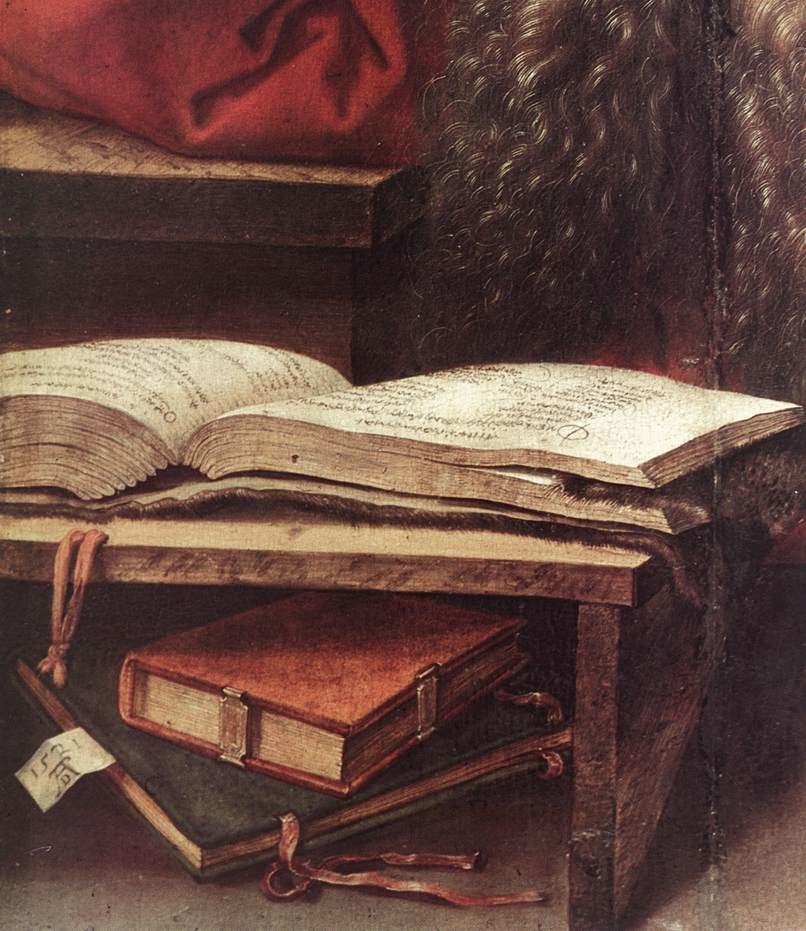
Albrecht Durer on the other hand took us somewhere else with the painting, St. Jerome in His Study, c. 1521. Seeming to represent a self-portrait, we are reminded of the death of Christ with his contemplation of death using a human skull. A small crucifixion appears in the background to take us on the Christian spiritual pathway he would have followed unto God. His writings do exist from a known Saint who lived near Greece somewhere. God gave him courage to follow his religious pursuits. He would have taken a vow of silence. The cross would have equalled his death. Durer, like many other artists to follow would have nominated this Saint as someone to follow. His dense contribution to the Christian order would feel like the study an artist pursues. The order of the cross.


Monday, May 5, 2014

121


Francisco de Zurbaran gave us San Francesco, c. 1635, an intense contemplation of the order. His bloodied hands hold a skull to contemplate the death of Christ on the cross. Flagellation and dense prayer ritual would have been his daily routine, hence the bloodied hands and sullied feet. Quite often this monastic order was taken too deep, down the wrong spiritual pathway to the garden of Christ equalling death and their hearts not being able to return to God. Almost life equalling death but the wrong way forwards. Gods divine garden cannot be taken through Hell. This Franciscan friar on the other hand would only be experiencing God.


Sunday, May 4, 2014

120


In Dorothea Tanning's own words, this was attributed to, with two works recently shown in Venice, one being, Self-Portrait, 1944 and The Truth About Comets, 1945. "In that camera-sharp place where planetary upheaval had lift its signature: the now placid monuments that, as far as anyone out there cared, had been there forever, I would undertake- "dare" would be a truer word- to paint the unpaintable." From Dorothea Tanning: Birthday and Beyond. This self-effacing of Dorothea Tanning, in her birthday suit, in the Arizona desert, the most photographed view, describes Tanning in her most raw emotional state, almost where God equals the cross. Her head-scape, post dreamscape, Surrealist landscape, where Max Ernst took Dorothea Tanning to live, in his own unconscious mind, apparently looking exactly where the Surrealists took his mind in Paris, post WW1 or the first world war. Most people would have had to reject Andre Breton for the wrong way forwards or political view, no one wanted a pre Hitler Nazi party regime. Everybody had to disperse any indication of extreme especial reform so during war most intellectuals are better off alone and went either to the country or to a different city during WW2. The comets painting takes you to what would be a regular sight in the desert there, especially after winter snow.


Saturday, May 3, 2014

119


Several times in the history of mankind people escorted the idea that the end of the world had come. Every new century seems to re-evaluate the century before and for some philosophers, the history of Christ. Yet again with the year 2000, notices were passed through the councils to stow freshwater and canned food in case of the end of the world. Christianity nominated the cross with the 1st Century AD. Philosophers and Saints went through the desert to try and understand God by studying the Heavenly way, the planetary sphere and the stars. Mathematical equations were reached. Going back to Venice, the Peggy Guggenheim Collection and the development of process through the early first half of the 20th Century, this extraordinary collection has some very fine examples of a kind of annihilation of the void. One such example is Leonor Fini's The Shepherdess of the Sphinxes, 1941. This incredibly strange dream fantasy landscape with a warrior princess as shepherdess and several female sphinxes in a kind of Yves Tanguy like Surreal landscape feels Armageddon in conception, maybe pre-war anxiety or simply Leonor Fini's own emotional state, the end of the world of some degree, her own cross to bear. The void was no black hole of philosophy equalling dark matter but an intense consideration of the philosophy on the cross.


Friday, May 2, 2014

118


The cross equalling God is somewhere the stars takes us to on a divine highway to man. The cross has been used as a floor plan for Christian churches, sometimes the pulpit, sometimes the altar, sometimes the twelve pointed star as the base of a Baptistery. Diagrams of Renaissance architecture take all your logical reason to God. They take your understanding to the kind of geometrical awareness man knows in his heart. The nomination of this divine no end philosophy has been re-equated again and again throughout the history of mankind. Bridge patterns for the soul. Early in the twentieth century there was another kind of evaluation taking place with automatic writing becoming dream philosophy and then the irrational inner understanding reaching the point of the heart, almost the God point, the tip, the very core of your being. Philosophy appears to follow the star patterns around as we spin on the axis. In the USA, Abstract Expressionism took abstract thinking to nature via the roof, a cathedral of understanding. In Europe there appears to be a more intellectual contemplation of an awareness of philosophy. Philosophy still dominates as something on the curriculum with any high school. The art on the other hand was taking a more philosophical viewpoint. Taking us all the way back to some of the Early Christian writings of philosophy in the first year of Christ, God equalling the Holy divine.


Piero della Francesca


Jackson Pollock


Thursday, May 1, 2014

117


Luca della Robbia gave us the Virgin and Child in a niche, c. 1460, recently exhibited in the Louvre. This really special gift unto God of a Springtime Child in the Renaissance is attributed through the heart of man and the inner goddess self of Luca della Robbia. His sculptures do have another quality that his then family siblings did not require. You imagine he would not have a wife and was probably a really intense human being, working day and night to evaluate this level of prowess next to the rest of the della Robbia company still in existence. The company of other Virgins this piece surrounded in the exhibition at the Louvre were also in reference and just as heart speak. God bless.